
Open for submissions 🚀
Plus enter our quantum micro-fiction competition, author interview with Stewart Hotston, & Colin the Copywriter on Ancillary Justice

Greetings, Carbon-Based Bipeds!
And welcome to the latest newsletter from the Arthur C. Clarke Award science fiction book of the year.
Our main headline is that submissions for books published in 2025 are now open and our judges are braced for incoming book mail.
The award is open to original authored works published in English by an author of any nationality, provided that the novel is published for the first time by a UK publisher between 1 January and 31 December of the current submission year.
Deadline for submissions is 31st December 2025: Contact us for our full submissions guidelines.
Micro-fiction competition with Science Gallery London

We’re delighted to be partnering with the Science Gallery London team on a special micro-fiction competition as part of their Quantum Untangled season.
The competition is open to entries from people aged 16+ from anywhere in the world for entries of original works of micro-fiction between 300-500 words.
Find out more: Full competition details and submissions portal.
Science Gallery London is the flagship public gallery and place to grow new ideas across art, science and health at King’s College London (also known for its famous alum Sir Arthur C. Clarke!)
Creating Space: Stewart Hotston in conversation
Clarke Award director Tom Hunter catches up with Stewart Hotston, science fiction writer, two-times Clarke Award judge, and new chair of the British Science Fiction Association.
His latest novel, Project Hanuman, is out now from Angry Robot books.
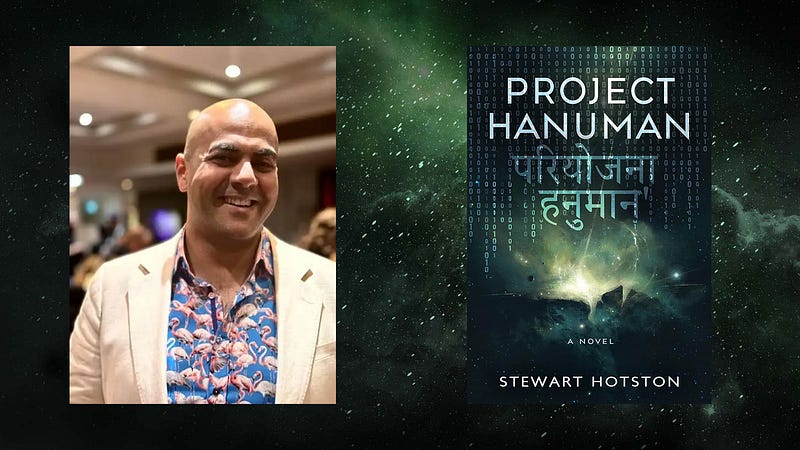
Tom Hunter: Hi Stewart, and thank you for agreeing to be interviewed. I was hoping that to start us off you could introduce yourself and your work to our readers.
Stewart Hotston: Hi, yes, I’m an author who’s largely known for SF. I’ve also been a judge for the Clarkes as well as currently being the treasurer of the BFS and as a councillor and now Chair for the BSFA.
I write non-fiction in a number of places — both essays and cultural criticism. My previous published longer work was The Entropy of Loss which was a finalist for both the BFS awards and for the Subjective Chaos awards.
My new book, the space opera Project Hanuman, is published by Angry Robot, and features microbial spaceships, information warfare, planets made of gold and grand ringworlds.
Tom: We know you best, of course, as a BSFA nominated judge for the Clarke Award. I was curious about how you found reading an entire year’s worth of UK published SF (twice!) and the impact, if any, on both your own writing and any wider understanding of the genre.
Stewart: The impact was broad. I found I recognised trends properly for the first time — when you’re reading everything publishers think is worthy of consideration you also get a sense of what the industry thinks is both commercial and substantial. Of course, you’re aware of trends and fashions, but seeing them first hand because you’re seeing literally everything, was a new experience for me.
I found the entire thing fascinating and although it was a tremendous amount of work, it was also really enjoyable.
I’m on record as saying I prefer juried awards over voted because although I think both approaches have strengths, you’re really unlikely to find diamonds in the rough rising to the top of voted awards. What really excites me is those stories that haven’t been as visible as others suddenly getting seen.
Tom: Long time followers of the award will remember you’ve also been instrumental in helping us analyse our own submissions data with an eye on EDI within the award itself and the wider publishing industry.
A tricky ask, but can you summarise some of the key findings and insights there, as well as areas for focus moving forwards for us?
Stewart: I’ve focused on looking at the proportion of British SF writers of colour in genre and statistically it is disproportionately low.
Although we have made strong progress in gender parity, there are typically more authors in translation than there are British authors of colour being published in the UK in any specific year. I’m keen we address that and have been working (with others) behind the scenes with a very receptive industry to see how we can change things since I first did that work.
For me there are some key areas that need support to change. The first is how we support writers of colour in coming to market — their experience can be markedly different to majority population writers, not least in facing explicit and less explicit racism in marketing, reviews and expectations.
The second is in creating space for people who’ve been historically excluded from publishing (either as writers or as publishers) to see this as something they can do, that it’s a place they can be welcome.
Somewhere behind that is the idea that not all stories need to be ‘the hero’s journey’ with an ‘arc where the character learns something’ and that there’s lots more variation because most of the world doesn’t look for the trends we’ve seen in English speaking media over the last fifteen years.
Tom: In our own reader research we’ve seen that a large percentage of fans of the Clarke Award might well be both buying and reading over 50 books a year but only 5 or so of those 50+ books being read will be a book published in its current year.
This stands as a radically different experience to the one you had as a Clarke judge, of course, but more importantly it also speaks to the complexities publishing companies have in terms of understanding their audiences, tracking trends and, crucially, making the internal case for new and more diverse books and writers being published.
Publishing is a business increasingly built on data but at the same time the unknown unknowns expose this as risk mitigation at best, guesswork at worst. How can we help construct a solid business case for publishers to embrace a diversity of authors for the long term when our data is so fragmented and open to multiple interpretations?
Stewart: The kinds of change I’m interested in are, brutally, the kinds that take a generation to bed in if you’re acting intentionally and have broad support.
The reason being is that so much of what I’d like to see addressed as assumptions about what works, what kind of people are reading and what they want to read (this is as much about gender and class as it is about culture and race).
That means we’re actually in a good place because we’re in a world in which we can only move the piano across the hall an inch at a time but, perhaps surprisingly, that’s exactly what we need to do.
The challenge is consistency across those kinds of timeframe. People come and go, our priorities naturally change and our energy levels vary. Life can get in the way of the things we want to accomplish — yet I still believe that setting out to intentionally change things and accepting that it’s a slow process is ok — as long as we accept it’s slow not because we’re being cautious, but because we’re being coordinated, committed and wise.
The changes need to happen in marketing as much as in writing and agenting and editing and commissioning. And that’s not to mention how we work with book buyers for retailers.
All the way through being careful with our data — and clear about what the moving parts are — will be the foundation on which we continue to make our arguments for change.
One of the big things I’ve found though is that people who would be allies on paper have only a limited amount of interest (for whatever reason) in actually helping, in rolling up their sleeves.
For many I think this is because there’s no existential threat to them if they don’t, so the feeling of urgency I carry with me as someone who’s lived a life of being racially abused, isn’t there.
This isn’t to judge them, really this ends up on those of us who are trying to build community and action — because we know people are busy already, that they have their own concerns. Whatever. But keeping people on the journey rather than relying on grand gestures is a much harder job because so many of us want to do one thing, check it off the list, and say we’re done.
In the current climate with the far right pushing back aggressively on anything resembling care for other people, empathy and equality, it feels like this is only more urgent now — today is the day to do something, to decide to help.
Ironically, science fiction is the best place for this — stories that explore how we build a different world because if we don’t look to the kind of world we want to build we’ll end up living in someone else’s version of it.
Colin the Copywriter on Ancillary Justice
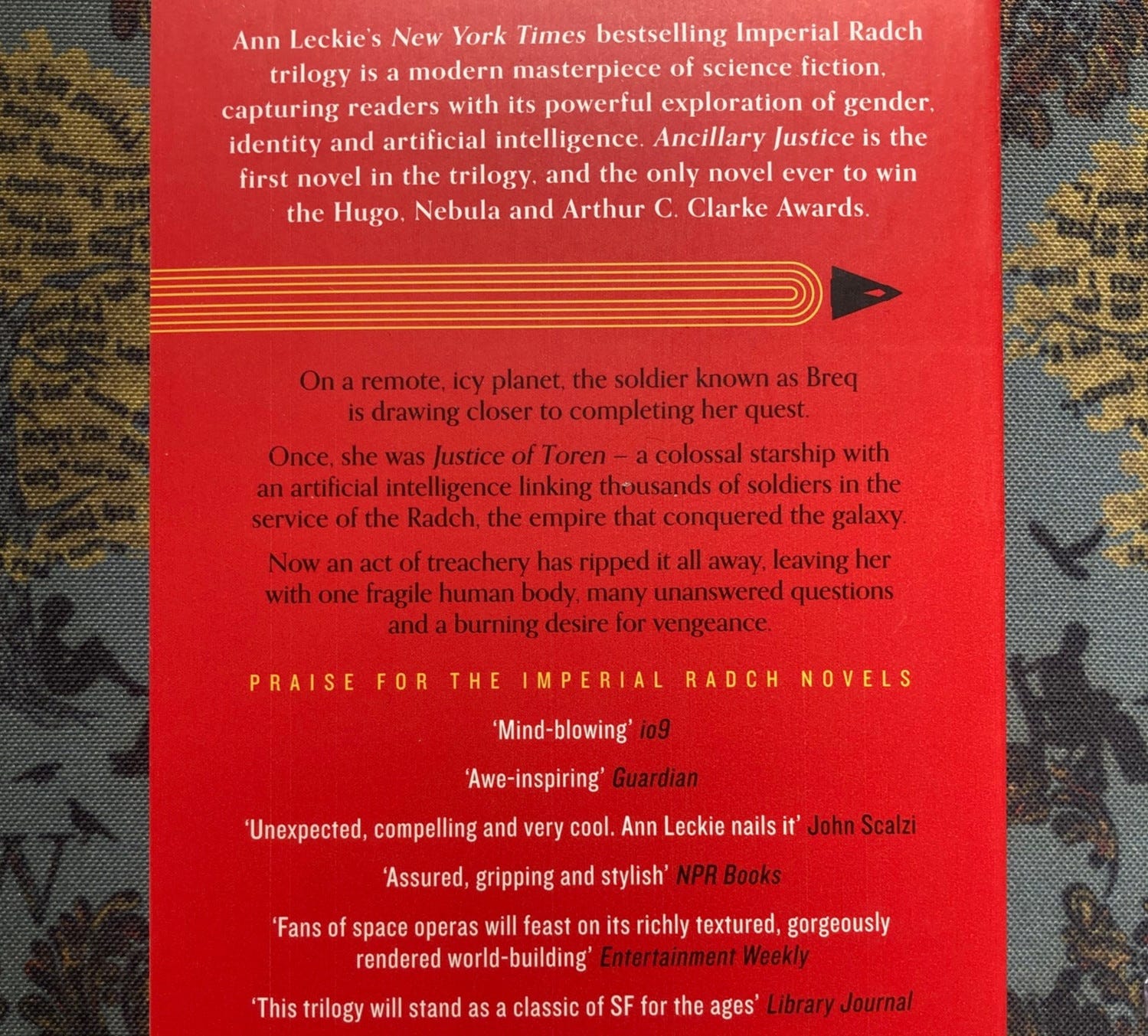
The blurb for Ann Leckie’s multi-award winner Ancillary Justice is a two-parter.
First, it tells you why should read this landmark trilogy (many prizes, a masterpiece, contemporary societal concerns).
Second, in 3 sentences, it pitches what the story is (a ship AI hive mind is stuck in a human body & wants answers) & how it works: treachery, quest, revenge.
Now you know why this book & trilogy are important, what it is all about & how the story is told.
A reader couldn’t ask for anything more...
For more insights into the mysterious art of book jacket copy creation follow Colin the Copywriter on Bluesky.
That’s it for this edition, thanks for reading!
Best wishes,
The Clarke Award team
